






Skip to content
  • Image
  • Facebook
  • Twitter
  • Youtube
  • Podcasts
  • Email
  • Subscribe to Ray’s Columns
  • Contact
The Arab Daily News

The Arab Daily News

Original news, features, opinions from Chicago to Jerusalem

  • About
    • About
    • Our Writers
    • Book Store
    • Contact
    • Submit Book Reviews, Press Releases
    • Privacy Corrections Policy
    • Profile on Ray Hanania
    • Submit Press Release
  • Features
    • Food
    • Book Review
    • Humor
    • Movies
    • Travel
  • Arab US Community
    • Arab Stores Targeted
    • Arab Community Network Page
    • Arab Heritage America resources
    • Directory
      • Groups & Organizations
      • Mosques, Churches
      • Restaurants
      • 2008 & 2014 Arab Media Directories
    • National Arab Heritage Month
    • Video: Chicago Arab History
    • Video: Photo Array of Chicago Arabs
    • Overview of Arabs in America
    • Hanania standup comedy
    • Arabs on the Titanic
    • Obituaries
  • Podcasts
    • Ray Hanania on Politics Podcast
    • Arab News Ray Hanania Radio
    • Arab Radio Podcast intro
    • Radio Baladi Detroit
    • TwoGuys on Politics
  • Ray on Tiktok
  • Subscribe Ray’s Columns
  • Archive 2004-2013
  • Toggle search form
  • Jamil Jimmy Ayesh Street Sign at 44th Hermitage
    Chicago to dedicate street in honor of Arab American businessman Jamil “Jimmy” Ayesh American Arabs
  • Cover of Ray Hanania's book "Arabs of Chicagoland" published in 2005 by Aracdia Publishing
    Publisher discounts offered on “Arabs of Chicagoland” book Activism
  • UN United Nations Human Rights Council
    Israel’s death penalty law constitutes discriminatory regime of capital punishment: UN experts Christian & Muslim
  • 03-30-26 Arab Center Washington DC Executive Director Jahshan and host Ray Hanania
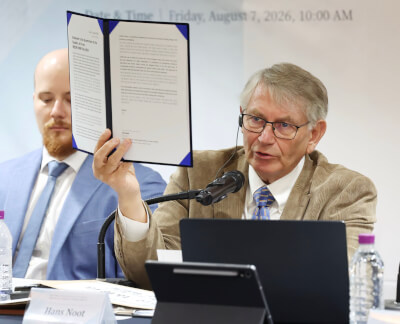
    Arab Center Washington D.C. hosts conference on Trump upending democracy and diplomacy April 9, 2026 American Arabs
  • National Arab American Heritage month Arab American Foundation April 2026
    National Arab American Heritage Month Launches April 1, 2026—Arab America Foundation Unites Communities Nationwide American Arabs
  • American Arab Anti-Discrimination Committee ADC Logo
    ADC Sues City of Miami Beach for Silencing Pro-Palestine Speech Activism
  • Heeb Magazine offers new podcast, and join Heeb Media Guild Activism
  • Jared Kushner's bppk.Distributed 500 to attendees at the March 25-27, 2026 FII Priority Summit in Miami at the Faena Hotel
    Jared Kushner tells it straight on Gaza and Iran at FII Conference Book Review
  • Ahmed Rehab Chicago CAIR Director
    CAIR-Chicago Stands with Mayor Brandon Johnson in Affirming Equal Protection Against All Hate Crimes American Arabs
  • Sawsan Abubaker, political consultant and deputy manager for Joseph "Joey" Ruzevich in the March 17, 2026 Democratic Primary election.
    Ruzevich race for Congress showcases challenges facing pro-Arab candidates American Arabs
  • Arab American Heritage Month Arab America Foundation April 2026
    Celebrate National Arab American Heritage Month 2026 American Arabs
  • American Arab Chamber with Trish Murphy
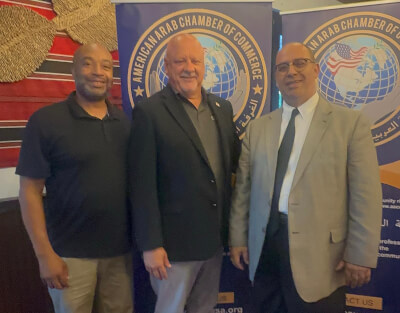
    American Arab Chamber of Commerce hosts Iftar with regional officials and community leaders American Arabs
  • Ex- Al Qaida Fighter: Al Qaida plans to attack the US on September 11 were public, CIA did noting to stop it Ali Younes
  • 03-03-26 Arab Center Guest Analysts
    Arab Center: The US-Israel War on Iran: Analyses and Perspectives Arab Center Washington DC
  • Accessible Sea and Aquatics Project
    The Accessible Sea & Aquatics Project (ASAP) Announces Capital Campaign for Advocacy and Programs Benefitting People with Disabilities in Lebanon American Arabs

Fighting Islamic State: Getting Down To Root Causes

Posted on September 30, 2015June 12, 2019 By James Dorsey No Comments on Fighting Islamic State: Getting Down To Root Causes
SHARE ...


  • Tweet


Click here to subscribe FREE to Ray Hanania's Columns

By James M. Dorsey

The rise of Islamic State (IS) beyond the borders of Syria and Iraq over the past one year has drawn comparison with the spread of communism more than a century ago. It has also pitted proponents of kinetic realpolitik seeking military defeat of the extremist against supporters of the notion that jihadism poses primarily an ideational threat.

However both schools of the debate focus on the violent nature of the threat and ways to neutralise it rather than on what has sparked the current menace that has been germinating and mushrooming over decades. Root causes figure in the competing visions of how the IS can best be confronted.

It has become common-place to speak of the need to tackle the root causes that make IS one of the most brutal insurgent groups in recent history, attractive to disaffected youth across the globe. Translating that notion into policy, however, is proving difficult, primarily because it is based on a truth that has far-reaching impact on the international community irrespective of how close or far its members are from the IS’ current borders.

It involves changing long-standing, ingrained policies at home that marginalise, exclude and stigmatise significant segments of society; emphasise security at the expense of freedoms and debate; and in more autocratic states that are abetted by the West, reduce citizens to obedient subjects through harsh repression and attenuation of religious belief to suit the interests of rulers.
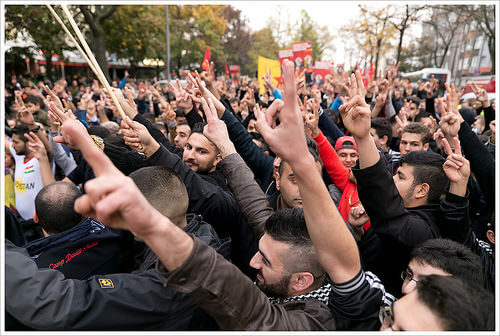
ISIS photo
Photo by Libertinus

Ultimately, IS has to be defeated not in its Syrian capital of Raqqa but in the dismal banlieues of French cities that furnish it with the largest contingent of European foreign fighters; the populous neighbourhoods in Tunisia that account for the single largest group of foreign fighters in Syria and Iraq; in Riyadh, Saudi Arabia, whose citizens account for the second largest number of foreign fighters and whose decades-ong effort to propagate a puritan, intolerant, interpretation of Islam has been a far more important breeding ground for jihadist thinking than the writings of militant Islamist thinkers like Sayyid Qutb; and in Western capitals led by Washington who view retrograde, repressive regimes like those of Saudi Arabia and Egypt as part of the solution rather than part of the problem.

Focussing on root causes means broadening scholarly and policy debate to concentrate not only on what amounts to applying Band-Aid that fail to heal the festering  open wounds but also to question assumptions made by the various schools of thought on how to solve the problem.

The facts on the ground have already convincingly contradicted the notion that IS will be defeated militarily. A year into military efforts, air strikes have failed to put a serious dent in IS’s appeal or the amount of territory it controls; Iraqi regular and irregular forces have been unable to shift the balance of power on the battlefield; and no other member of the 60-nation coalition assembled by the US has been willing to deploy a ground force that potentially could defeat the jihadist group.

Yet, even such a hypothetical defeat would not solve the problem. Al Qaeda was degraded, to use the language of the Obama administration. Instead of reducing the threat of political violence, it produced ever more virulent forms of it, embodied by IS. It may be hard to imagine anything more brutal than IS, but it is a fair assumption that defeat of the group without tackling root causes would only lead to something that is even more violent and vicious.

There is much to be said for the notion of containment rather than defeat of IS in the belief that over time it would be forced to adapt its expansionist ambitions and brutal tactics as reality kicks in and the responsibility of government forces it to come to some kind of accommodation with the international community. Containment addresses the immediate problem but ignores factors that fuel radicalisation far from the warring state’s borders and make jihadism attractive to disaffected across the globe.

Similarly, the notion that the very existence of IS poses a greater threat to regional stability and security in the Middle East and North Africa than conventional or unconventional military power elevates jihadism – the violent establishment of pan-Islamic rule — to the status of a root cause rather than a symptom and expression of a greater and more complex problem.

Moreover, the ideological challenge posed by IS despite its discriminatory, exclusionary, narrow-minded interpretation of Islam, is primarily its equally problematic readings of the faith. IS shares some puritan concepts with Saudi Arabia’s Wahhabism but rejects notions of monarchic rule and a clergy that uses puritanism to bolster the power of an autocratic family. IS’s caliphate contradicts Iran’s concept of the velayat-e-faqih, the Guardianship of the Islamic Jurists. Its model of governance opposes the Muslim Brotherhood’s precepts, and ideas propagated by Egypt and the United Arab Emirates of an Islam that first and foremost prescribes absolute obedience to a ruler.

In other words, the ideological debate waged in the Muslim world is to a large extent dominated by schools of thought that do not advocate more open, liberal and pluralistic interpretations of Islam. That is where the real challenge lies. The international community would give more liberal Muslim voices significant credibility if it put its money where its mouth is. It should offer a pallet of policy options that take a stab at rooting out the problem and its underlying causes rather than confine it to self-serving regimes and their religious supporters.

Some of those who emphasise IS’ ideational challenge warn that jihadism, like concepts of Arabism and Arab nationalism that were popular in the past, could provoke conflict in and between Arab states. Reality on the ground has put that notion to rest. IS with its territorial base, coupled with multiple other factors, has demonstrated the fragility of existing Arab nation states and likely condemned to dustbins of history notions of Syria and Iraq as the nation states the world has known since the end of colonial rule.

By the same token, reducing the significance of recent attacks on mosques and tourist sites by IS fellow travellers in Tunisia, Kuwait, Egypt and Saudi Arabia‎ to challenges to the political legitimacy and authority of those states, is to fail to recognise that IS fundamentally feeds on the failures of those regimes. These include the failure to provide their youth social and economic opportunity, and to adopt policies that are inclusionary not exclusionary, pluralistic not discriminatory, and encourage participation in political debates and processes rather cutting off all avenues for expression of discontent. Therein lie the root causes of the jihadism threatening the international community.

James M. Dorsey is a senior fellow at the S. Rajaratnam School of International Studies, co-director of the University of Würzburg’s Institute for Fan Culture, and the author of The Turbulent World of Middle East Soccer blog and a forthcoming book with the same title.

Photo by Libertinus


Click here to subscribe FREE to Ray Hanania's Columns

  • About
  • Latest Posts
James Dorsey
Follow Me
James Dorsey
James M. Dorsey is a senior fellow at the S. Rajaratnam School of International Studies as Nanyang Technological University in Singapore, co-director of the Institute of Fan Culture of the University of Würzburg and the author of the blog, The Turbulent World of Middle East Soccer, and a forthcoming book with the same title.
James Dorsey
Follow Me
Latest posts by James Dorsey (see all)
  • Soccer highlights domestic drivers in Saudi-Iranian dispute - January 4, 2016
  • Soccer: Iranian moderates and hardliner lock horns on the pitch - December 29, 2015
  • Trade unions test Qatari sincerity with demands for labour reform - December 20, 2015
NVP: 119

  • Tweet

SHARE ...


 Tweet 
Arab World Tags:ISIS

Post navigation

Previous Post: Netanyahu at the UN and the War on BULLSH*T!
Next Post: صلاة العيد في ملعب القبة البيضاء في منطقة برجفيو

Related Posts

  • Middle East Christians get training to reinforce faith Arab World
  • Arab News Editor-in-Chief Faisal J, Abbas (L) and FII Institute CEO Richard Attias.
    Arab News, FII Institute partner to shed light on the future of regional media industry Arab World
  • Violence in Israel defined by hypocrisy and race Arab News
  • Setting the record straight: Saudi women’s oppression Arab World
  • HRH Ambassador Reema Bandar Al-Saud
    Saudi Arabia’s US Ambassador slams Washington Post for editorial stereotyping Saudi women Arab News
  • A Day Without a Woman and the USS LIBERTY American Arabs

More Related Articles

Dear French President Macron: Anti-Zionism Is NOT a Form Of Anti-Semitism Arab World
Snow Storms Threatens Syrian Refugees Activism
Saudi Crown Prince Mohammad bin Salman Al-Saud. Photo courtesy of Wikipedia Saudi Crown Prince to tour United States cities Activism
Mission from God Regarding Israel’s Nuclear Whistleblower Mordechai Vanunu Arab World
Bibi Khadija’s leadership is the need of the day for Muslims Arab News
International Women’s Day, Alfred Nobel and Mother’s Day American Arabs

Leave a Reply Cancel reply

You must be logged in to post a comment.

  • OPINION COLUMNS
  • 02-12-26 Ray Hanania on Marc SIms Podcast
    Ray Hanania joins Marc Sims podcast on censorship, Bad Bunny and racism
    February 12, 2026
  • Arab Center Washington DC
    Arab Center Analysis: Israel’s declining support among American Evangelicals 
    January 1, 2026
  • Akram Baker
    Akram Baker remembered, worked at Orient House in Jerusalem with the late Faisal Husseini
    December 12, 2025
  • 10-01-25 Arab Center Web Ad 300x300
    The CMCC and the US-Israel Alliance: Collusion or Enforcement Mechanism?
    December 5, 2025
  • Source: United Nations Office for the Coordination of Humanitarian Affairs
    Construction in the E1 Area: Preventing Palestinian Geographical Contiguity
    October 27, 2025

Couyrageous Thought: Hanania Syndicated Columns

Ray Hanania courageous Thought website logo
Ray Hanania

Enter Your Email to Subscribe to Ray Hanania’s Columns

Creative Commons License
All work on this website is licensed under a Creative Commons Attribution 4.0 International License. Do not edit original work. Give credit to the original source. Some photos published with permission from Zemanta and Wikipedia.

The Lightning Strike Radio Sun 8-10 AM

Mohammed Faheem The Lightning Strike Radio Show
  • NEWS
  • Jamil Jimmy Ayesh Street Sign at 44th Hermitage
    Chicago to dedicate street in honor of Arab American businessman Jamil “Jimmy” Ayesh
    April 23, 2026
  • Cover of Ray Hanania's book "Arabs of Chicagoland" published in 2005 by Aracdia Publishing
    Publisher discounts offered on “Arabs of Chicagoland” book
    April 21, 2026
  • UN United Nations Human Rights Council
    Israel’s death penalty law constitutes discriminatory regime of capital punishment: UN experts
    April 9, 2026
  • National Arab American Heritage month Arab American Foundation April 2026
    National Arab American Heritage Month Launches April 1, 2026—Arab America Foundation Unites Communities Nationwide
    April 1, 2026
  • 03-30-26 Arab Center Washington DC Executive Director Jahshan and host Ray Hanania
    Arab Center Washington D.C. hosts conference on Trump upending democracy and diplomacy April 9, 2026
    March 31, 2026
  • New-iTunes-1400-x-1400-The-Ray-Hanania-Show-Podcast-Icon-300-x-300.jpg
  • Podcast-iTunes-Logo-Chi-City-Hall-1985.jpg
  • terroristbookcover-300-x-300.jpg
  • The-Kings-Pawn-Book-300-x-300.png
  • powerpr300x300ad.jpg
  • NEWSWIRE
  • Jamil Jimmy Ayesh Street Sign at 44th Hermitage
    Chicago to dedicate street in honor of Arab American businessman Jamil “Jimmy” Ayesh
    April 23, 2026
  • Cover of Ray Hanania's book "Arabs of Chicagoland" published in 2005 by Aracdia Publishing
    Publisher discounts offered on “Arabs of Chicagoland” book
    April 21, 2026
  • UN United Nations Human Rights Council
    Israel’s death penalty law constitutes discriminatory regime of capital punishment: UN experts
    April 9, 2026
  • National Arab American Heritage month Arab American Foundation April 2026
    National Arab American Heritage Month Launches April 1, 2026—Arab America Foundation Unites Communities Nationwide
    April 1, 2026

Follow Ray Hanania at
Twitter
Facebook
TitkTok
BlueSky
RayHanania Columns

Click here to get information on The Ray Hanania Radio Show and its podcasts

Copyright © 2026 The Arab Daily News.

Powered by PressBook Premium theme