




Maria Pappas shares stories of hardship, faith, and Hope behind new memoir at Pakistani-American Community gathering
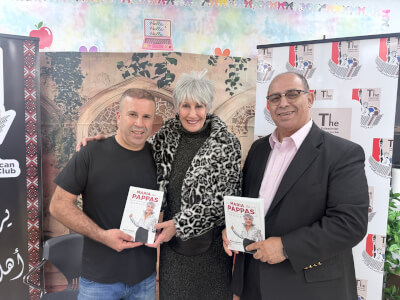
Author Maria Pappas discusses her new memoir “Maria the Pappas,” telling an audience at Sabeel Center in Des Plaines how her Greek immigrant roots, a traumatic childhood, and a lifetime of helping others shaped her journey into public service. Video of event below.
By Ray Hanania
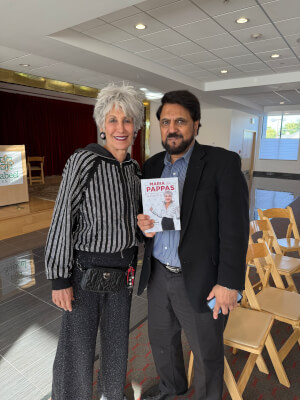
DES PLAINES, IL — Cook County Treasurer Maria Pappas shared deeply personal stories about her childhood, her family’s immigrant struggles, her religious faith and the experiences that shaped her career in public service during an emotional discussion of her new memoir, Maria the Pappas, at the Sabeel Center in Des Plaines on Sunday, October 11.
Speaking before members of the Pakistani-American and Muslim communities, Pappas described how her upbringing in a Greek immigrant family in West Virginia coal country, including a traumatic experience involving her mother’s psychiatric treatment, inspired a lifelong determination to help people overcome hardship.
Pappas was introduced by activist Salman Aftab.
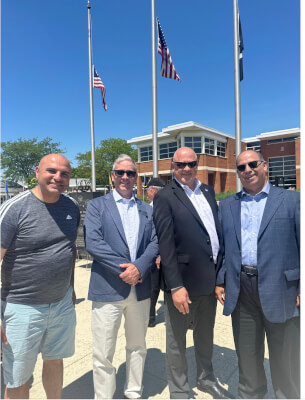
“She is one of the best in the state of Illinois. Thank you so much for everything you’ve been doing, Maria Pappas. Honorable Maria Pappas. I would also like to offer a special thank you to Doctor Munir Chaudry for opening the doors of this wonderful Sabeel Center,” Aftab said, also acknowledging, among the audience of nearly 100 people, Maine Township Trustee Asif Malik, journalist Rana Javed, and Pakistani Consul General Zaman Mehdi.
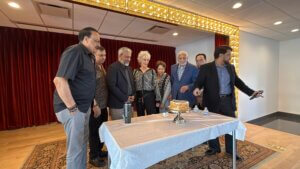
“This is co-hosted by the Sabeel Center and IFANCA, the Islamic Food and Nutrition of North America, which is unique. These two organizations are very unique for the Muslim community of Illinois, and nationwide, because there is no other organization like IFANCA.”
Pappas, 77, told the audience that her memoir is more than an account of her personal achievements. It is a story about immigration, discrimination, family, faith, and the importance of preserving cultural identity for future generations.
“It’s time to tell my story because it’s such an amazing story that really hits the heart of the hundred and twenty-seven ethnic groups in Cook County that I work with,” Pappas said.
She explained that immigrant families often share similar experiences, regardless of their religious or ethnic backgrounds.
Most, she said, came to America with little and spent generations working through their communities, religious institutions and cultural organizations to provide better opportunities for their children.
Pappas said she decided to write her memoir after a frightening medical experience three years ago, when complications following double knee replacement surgery nearly took her life.
She recalled spending six days hospitalized with breathing tubes after what she described as a medication error involving an opioid.
After surviving the ordeal, she decided it was time to document the experiences that had shaped her life.
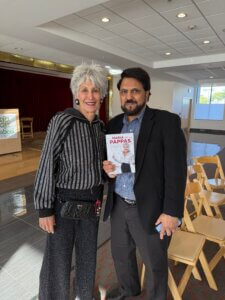
From Crete to West Virginia coal country
In her memoir, Pappas traced her family’s roots to the Greek island of Crete, explaining that her grandparents immigrated to the United States in the early 1900s.
Some initially settled in Salt Lake City, Utah, where Greek immigrants worked in the salt mines. But discrimination eventually pushed the family eastward to West Virginia, where the mountainous landscape reminded them of Greece.
“The Greeks were looked down on. But they were hardworking, and we never realized that we were poor because there was always a lot of food in the house,” Pappas recalled.
Her family eventually operated a restaurant across from a hospital near Wheeling, West Virginia.
As a young child, Pappas delivered meals to hospital patients and spent time speaking with their relatives.
Those experiences, she said, taught her to listen to people and understand their suffering.
“My life and your life and our lives are always marked by what happens to us as a kid,” Pappas said. “It’s the early childhood memory.”
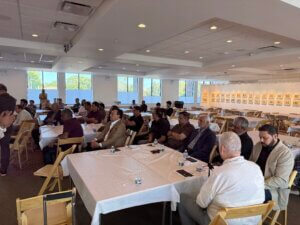
One of the most painful experiences occurred when she was just 10 years old.
Pappas recalled waking up one night to learn that her mother had been taken to the hospital. Weeks passed without her mother returning home.
When Pappas demanded answers, she learned that her mother was under the care of a psychiatrist.
According to Pappas, the doctor blamed her for her mother’s condition and eventually brought her to a hospital psychiatric ward, where she found her mother confined and unable to recognize her.
Pappas alleged that her mother had been subjected to electroshock treatments and inappropriate medication.
Determined to help her mother recover, Pappas said she secretly began removing small amounts of medication from her mother’s pills over a two-year period. She attributed her mother’s eventual recovery to those actions, although her account does not independently establish what caused the improvement.
“So I decide that I am going to make her well. I decide that I am going to fix her,” Pappas said.
That childhood determination, she explained, became a defining characteristic of her life.
“You’re gonna see hundreds of stories about how I then go out and try and fix people and fix governments and fix countries.”
Arriving in Chicago with $500
Pappas described how her early experiences eventually led her into psychology, education, law and politics.
While studying at West Virginia University, she encountered a prominent psychiatrist who encouraged her to leave West Virginia and pursue further education in Chicago.
Against her parents’ wishes, Pappas moved to Chicago in 1972 with just $500.
She spent her first night at the Allerton Hotel, where she recalled encountering police investigating a murder.
Her father had warned her about Chicago’s reputation for organized crime, and the experience initially frightened her.
But Pappas persevered, eventually entering a doctoral program at Loyola University and beginning a career in psychology.
She also worked in Chicago’s Altgeld Gardens community, where she headed a drug abuse clinic and advocated for treatment rather than incarceration for people struggling with addiction.
Pappas recalled representing the interests of troubled individuals in court, including a young man whose criminal behavior followed a traumatic childhood incident involving the accidental death of his younger brother.
After hearing her explanation of the young man’s history, a judge encouraged her to become an attorney.
She subsequently entered law school, eventually establishing a legal practice.
Pappas said her work also took her overseas, where she taught psychotherapy and worked with individuals struggling with addiction.
She recalled traveling to Greece at the request of Greek political leaders to address drug abuse among wealthy families.
One encounter involved a pregnant woman who had unsuccessfully sought treatment at expensive clinics across Europe.
Pappas said she told the woman that she could not help her after so many other specialists had failed.
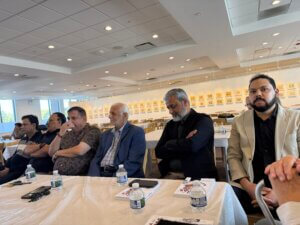
According to Pappas, the woman subsequently stopped using drugs, an experience she described as demonstrating the power of honesty.
“Overnight I became famous in Greece as an expert for just telling somebody the truth,” she said.
Her experiences as a psychologist and attorney ultimately led her into public office, first as a Cook County commissioner and later as Cook County Treasurer.
Faith, family and the search for meaning
Throughout her remarks, Pappas emphasized the importance of religious faith in helping her confront personal suffering.
She drew parallels between her Greek Orthodox upbringing and the importance of faith within the Muslim community.
“At the time, I was very involved in the church anyway, just like you’re very involved in your mosques,” Pappas said while recalling her mother’s illness.
Her memoir includes accounts of visits to churches and monasteries in Greece and concludes with her participation in a major Orthodox religious ceremony in Bucharest, Romania.
Pappas also described how the deaths of her parents led her to seek spiritual comfort in Crete.
After her mother’s death, she traveled through the mountains of Crete, eventually hiking into a gorge where she discovered a church named Agia Irini, or St. Irene, the same name as her mother.
Overwhelmed by grief, she fell to the ground and cried.
Later, following her father’s death, Pappas returned to Greece and encountered a monk at a mountain monastery.
The monk, who shared his own story of overcoming addiction and illness, offered her a simple message.
“Nobody ever dies,” he told her.
Pappas said those words transformed how she understood death and grief.
“And I never cried again,” she recalled.
A painful reminder that not everything can be fixed
Pappas also shared a recent family tragedy involving her grandson, who underwent surgery for a brain tumor.
She described watching family members struggle with the diagnosis and uncertainty about his future.
The experience, she said, confronted her with something she had never fully accepted: that some problems are beyond her ability to solve.
“I think God, whoever this God is, sent me this situation because this is the one thing in my life I can’t fix,” Pappas said.
“I can’t make him well. But along the way, I was able to make a lot of people well, and I was able to make a lot of people happy, and I was able to change a lot of lives.”
The experience reinforced her belief that the value of a person’s life should be measured by the difference they make for others.
A message for immigrant families
The event was organized with the involvement of Pakistani-American community leader Salman Aftab, who praised Pappas for her longstanding outreach to Cook County’s diverse ethnic and religious communities.
Pappas concluded by urging audience members to preserve their cultural traditions and pass their family histories to their children.
“You’ve been discriminated against. You’ve had to find your God. You’ve had to push to keep your ethnocentricity and your customs and your traditions alive from what your great-grandparents and your parents gave to you,” she said.
“One of the greatest problems in America is that we’ve forgotten who we are.”
Pappas said the central message of Maria the Pappas is not about political power, wealth or professional success, but about finding purpose through service.
“So when you read this book, this book is not for you. It’s for your children. It’s for the next generation to understand that, you know, along the way, you can really make a difference.”
Despite knowing wealthy and influential people around the world, Pappas said she considers herself extraordinarily rich because of the happiness and purpose she finds in helping others.
“I wake up in the morning, I’m the richest person in the world,” she said. “I wake up in the morning happy.”
She ended her remarks by describing the memoir as a reflection of the experiences that transformed a young Greek-American girl from West Virginia into a public servant whose work has touched countless lives.
“That’s what the book’s about. It’s just good reading. It’s a story about hope.”
For more information on Maria Pappas’ memoir, Maria the Pappas, visit the website www.MariaThePappas.com.
Order a copy of the book from Amazon.com by CLICKING THIS LINK.
Click this link to view the video, or use the widget below:


Click here to subscribe FREE to Ray Hanania's Columns

His award winning columns can be found at www.HANANIA.COM Subscribe FREE today
Hanania also writes about Middle East issues for the Arab News, and The Arab Daily News criticizing government policies in the Israeli-Palestinian conflict.
Hanania was named "Best Ethnic American Columnist" by the New America Media in November 2007, and is the 2009 recipient of the SPJ National Sigma Delta Chi Award for column writing.
Email Ray Hanania at [email protected].
Follow RayHanania at Twitter
- Maria Pappas shares stories of hardship, faith, and Hope behind new memoir at Pakistani-American Community gathering - October 16, 2026
- Maria Pappas shares immigrant roots, personal tragedies and lessons of faith at Arab American community book signing - October 12, 2026
- Arab Center features analysis on what Iran Reveals about China’s Middle East Strategy - October 2, 2026