




Special Adviser on Iran spells out war crimes of Qassem Suleimani and Iran
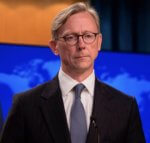
President Trump’s U.S. Special Representative for Iran and Senior Policy Advisor to Secretary of State Brian Hook presents briefing on expanded sanctions on Iran and takes questions from some reporters. Hook detailed specifics about Qassem Suleimani’s killing of Americans, but defends Israel against charges of hypocrisy over its secret and uninspected nuclear weapons.
Official Transcript
Moderator: Hi, greetings to everyone from the U.S. State Department’s Media Hub in Brussels. I would like to welcome our participants dialing in from around the world and thank all of you for joining this discussion.
Today, we are pleased to be joined by Brian Hook, the State Department’s Special Representative for Iran and the Senior Foreign Policy Advisor to the Secretary of State. We will begin today’s call with opening remarks, and then we will turn to your questions. We will do our best to get to as many questions as possible in the time that we have, which is approximately 30 minutes.
As a reminder, today’s call is on the record. And with that, I will turn it over to Special Representative Hook.
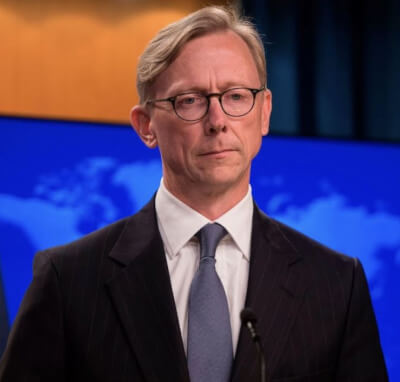
Mr. Hook: Thank you, Vanessa. Thanks, everybody, for joining the call. I was just with the Secretary of State and the Secretary of the Treasury over at the White House to announce our – the actions that we took today to hold Iranian regime officials responsible for the attacks against U.S. personnel and interests.
We are also with these actions depriving the regime of the revenue that it needs to conduct its violent and expansionist foreign policy. The maximum pressure campaign on Iran is continuing, and it is increasing.
Let me talk broadly about the three – I’ll take these sort of one segment at a time.
We announced sanctions on Iran regime officials, specifically eight Iranian leaders – including Ali Shamkhani, who is the secretary of the Supreme National Security Council; and the commander of the Basij, Soleimani – also six other senior officials. And they have been designated pursuant to Executive Order 13876 for being appointed by or acting on behalf of the Supreme Leader.
What’s important about these officials is these eight have carried out Iran’s terror plots and campaigns of mayhem across the region, and they are complicit in the recent murders of around 1,500 Iranians protesting their freedom.
As you know, the Secretary of State created a tip line for the Iranian people to submit photos and videos and evidence of regime abuse. We have sanctioned the Minister of Communications and Technology for turning off the Internet shortly after the protests ended. We’ve also sanctioned some judges. And then today, we’re sanctioning eight senior Iranian leaders who were involved in brutalizing the Iranian people.
I’ll talk a little bit about the three actions we took today on Iran’s metal industry. The Iranian regime uses revenue from its metals industry to fund its foreign policy. And so today we sanctioned 22 organizations and three vessels, and these are vessels that have been operating in the iron, steel, aluminum, and copper sectors of Iran in related activities.
Last thing I’ll mention before taking questions is the President signed an executive order and he’s issuing an executive order that authorizes the United States to impose sanctions on any person operating in or trading with construction, manufacturing, textiles, and mining sectors. This order is going to have a major impact on the Iranian economy and leadership because it authorizes sanctions on export sectors that are keeping the Iranian economy on life support.
All of these sanctions will remain in place until the regime changes its behavior. The United States is ready to embrace peace with all who seek it. As the President said yesterday, he is, again, opening the door to diplomacy. He would like to see a new deal to replace the Iran deal so that we can resolve our differences with Iran diplomatically. And we invite Iran to do the same and to not meet our diplomacy with military force.
Happy to take some questions.
Moderator: Thank you for those remarks. Our first question comes to us from – it was submitted in advance by Frank Sujak, with Deutsche Welle, in Germany. He asks, in his address on Wednesday, President Trump said he wanted a greater role for NATO in the Middle East. What specifically is the United States seeking? And what consensus-building efforts are underway to convince the UK, Germany, France, Russia, and China of the U.S. plan for dealing with Iran’s nuclear ambitions? He also asks what additional powerful sanctions will the U.S. impose on Iran?
Mr. Hook: The President yesterday spoke about NATO at length, and so I don’t have much to say beyond that. The President thinks that NATO should be expanded, and it should include the Middle East. And what we’re dealing with in the case – and it’s – this is an international problem. And so he does think that the scope of NATO should be increased.
And on Monday, at the beginning of this week, I addressed all of NATO and explained the defensive actions that we have taken to confront Iranian aggression, to defend ourselves against attacks, and to restore deterrence. And in the last couple of weeks, you have seen the President authorize defensive military strikes in Iraq and Syria. We managed the attack on our embassy in Baghdad by Iranian and other terrorists. And then you also had the elimination of Qasem Soleimani, also a defensive strike to prevent him from attacking hundreds of Americans – potentially hundreds of Americans in a large-scale attack.
So I would refer you — the President did speak at length about NATO yesterday, and I refer you to those remarks.
Moderator: Thanks for that answer. Our next question comes to us from Thanasis Athanasiou from the Omega Channel in Cyprus. Thanasis, go ahead with your question.
Question: Hello?
Moderator: Yes, go ahead.
Mr. Hook: There you go. Yes, go ahead – yeah, go ahead with your question.
Question: Okay, I will repeat. Does the U.S. have any plans for using Cyprus as an operation base, not just for humanitarian reasons?
Mr. Hook: In terms of operations, it sounds like a DoD question, and not a diplomatic question, so I would refer you to DoD for an answer on that.
Moderator: Thanks for that answer. Our next question comes from Thomas Nehls with ARD Radio in Germany.
Question: Yes, hello from Berlin.
Mr. Hook: Hello.
Thomas Nehls with ARD Radio: Mr. Hook, I’m old enough to remember talks about a nuclear-free weapons zone in the Middle East. Mr.—Mr.—Senator McCain talked about that during the Munich Security Conference. But then suddenly in the late ‘90s, it stopped. Is there any chance to get back to that issue, including the nuclear weapons being stationed in Israel, maybe even Pakistan and India. But that’s not the Middle East. So to that – asking about that issue, and if I may add, why isn’t it at all that populations should be more afraid of the non-existing nuclear weapons in Iran rather than of the existing nuclear weapons in Israel?
Mr. Hook: I don’t have any comment on anybody else’s policy on nonproliferation. I can only explain our policy on it. The Islamic Republic of Iran is the world’s largest state sponsor of terrorism, and they are in the most volatile region in the world. Iran can never acquire a nuclear weapon. It would be catastrophic for the Middle East.
And if you think we have problems now keeping a lid on the region, imagine the Islamic Republic with a nuclear weapon. And so I’m not aware of anybody in the world that thinks it’s a good idea for Iran to have a nuclear weapon. And so your question about the nonexistent nuclear weapon, I think doesn’t fully appreciate the – this regime’s history of wanting to become a nuclear weapons state. And if anybody who has studied it would recognize this is not something that we can be glib about and to dismiss it as not a big deal.
The Israelis liberated a half a ton of materials from an armed warehouse in Tehran, and these are materials that demonstrate that the regime has kept the owner’s manual on how to build a nuclear weapon. And now that we’re outside of the Iran Nuclear Deal we’re in a much better position to deny Iran a nuclear weapon.
But it also allows us to then really forcibly respond to Iran’s regional aggression, and that’s what we’ve done with our sanctions. We have – this regime is facing its worst financial crisis and its worst political unrest in its 40-year history. And so the regime has very bad options right now. They are in a state of panicked aggression. And so we’re just in a much different place now. We’re very pleased with our policy which is the right nonproliferation policy to make the Middle East free of, the sort of the nuclear threats, that countries like Iran presents.
Moderator: Thanks very much for that answer. The next question comes from Arshad Mohammed from Reuters.
Question: Thanks for doing this.
Mr. Hook: Sure.
Question: Could you explain – first, could you explain precisely –
Mr. Hook: Can you speak up?
Moderator: I’m sorry. Arshad, there’s some – there’s some noise in the background. Could you speak into your – directly into the receiver?
Question: Sure. I’m trying to speak right into the receiver now, can you explain to us – can you explain to us exactly how it is the sanctions that you announced on the eight Iranian officials add to the prior sanctions that are already on some of them? For example, Shamkhani has already been sanctioned, so what is additional as a result of today’s action under 13876?
Secondly, can you explain to us exactly what is additional in today’s sanctions on the metals industries, which at least steel and iron and I think also aluminum had previously been sanctioned? And then finally, can you explain to us – well, I’ll leave it at those two.
Mr. Hook: The United States has many different authorities. Some of them come from Congress. Some of them derive from executive orders issued by the President. There are many different angles that we can take on this. Some may involve the nuclear dimension piece. Some may involve terrorism. Some may involve cyber, human rights abuses, missile counter-proliferation. We have a range of authorities.
We do not miss any opportunity to use these authorities when we can. And so you have seen this phenomenon of people being sanctioned more than once. It’s because we’re using different authorities that cover different threats, and that allows us to have a wraparound effect on these various individuals.
It’s also really important for us to go after Iran’s shock troops, the Basij, which have been murdering Iranians who have been fighting for their freedom and, in fact, would just like a normal government – a more representative government.
So when we do this it has a substantive effect, but it also signals to the Iranian people that we stand with them and their demands for a more representative government.
Moderator: Thanks for that answer. For our next question, we’ll go again to a question submitted in advance from Allan Kaval with Le Monde in France. He asks: Do you believe Iran has actually concluded its retaliation? Or is there is a risk that the IRI might come back using its proxies in order to harm American and allied interests in the region and resorting to the usual deniability tactics that Iran has been resorting to since last May?
Mr. Hook: Could you just give me the very first part of the question again?
Moderator: Do you believe that Iran has actually concluded its retaliation? Or is there a risk that they might come back using their proxies?
Mr. Hook: Well, Iran has said – I think Foreign Minister Zarif, I think he used the word concluded. I don’t have the words in front of me. But it would seem that Iran has concluded its response in retaliation for the killing of Qasem Soleimani. That’s a question for Iran. I’m not speaking for them.
But we hope that Iran starts making better decisions and does not continue to pursue its aggressive and expansionist foreign policy either directly or through its proxies.
On September 11th of 2018, the White House issued a statement which was a new policy for the United States that we don’t make a distinction between the Iranian regime and its proxies. And Iran, the regime, will be held accountable for the attacks of its proxies. And you saw that after an American was killed by Kata’ib Hizballah on December 27th that the President then responded and struck command centers of Kata’ib Hizballah in Iraq and Syria. We’re going to continue to do that to act defensively. The President exercises his inherent authority to act in self-defense when attacked. He will continue to do that. But we continue to urge the Iranian regime to de-escalate, as other countries have, and to take the diplomatic off-ramp that has been presented time and again by the United States, by Japan, by France, by so many countries around the world.
Moderator: Thank you. Our next question comes to us from Jennifer Hansler with CNN.
Question: Hi, thanks so much for doing the call. I wanted to ask a couple of questions. Firstly, Brian in your opening you mentioned that twenty-two entities and three vessels have been sanctioned. But the notice we received from the Treasury only mentioned twenty entities and one vessel. Can you explain the discrepancy there?
And then secondly, on the President’s assertion that Iran was targeting a U.S. embassy, you’ve said you’ve seen all the U.S. intel that led up to that point. That was the first we had heard about that. Can you explain where that threat came from and a little more about the nature of it?
Mr. Hook: On your second question, you said that I had seen the intel. But what was your question about it?
Question: Whether it showed that Iran was planning to attack on the U.S. embassy?
Mr. Hook: So on the first question, I will defer to the Treasury official statement. And if there’s a variance of one or two on either side, please defer to Treasury on that.
On the—Qasem Soleimani was traveling in the region, and the IRGC confirmed it publicly – he was traveling in the region for the purpose of organizing attacks. And we have said that Qasem Soleimani was targeting diplomatic facilities and he was also targeting American service members. So he was looking at diplomats and he was looking at service members. Not the first time because he had orchestrated the attacks – repeated attacks on Iraqi military bases that were hosting American and coalition forces.
So this wasn’t the first time that he has done this. They have been – he has been organizing proxies in Iraq for some time. When we had him in the region planning imminent attacks against American – against American people and against American interests, the President then took decisive action.
If we had not taken that action and hundreds of people had died, you would be asking me now why didn’t we do more to prevent Qasem Soleimani from killing so many people. And so given his record, he was very effective and he was very lethal. And for those who have studied his 21-year history, he was Iran’s indispensable man because he was the glue that held together the proxy forces in the gray zone.
And so he has – himself is responsible for the murders of over 600 Americans. And when a man of that lethality and skill is in the region plotting attacks, and our intelligence was solid on this, the risks of doing nothing were much greater than the risks of eliminating him.
And it was the right decision. I was in Los Angeles the first part of this week. It’s the largest – Los Angeles is home to the largest Iranian diaspora in the world, and we received enormous support for the President’s foreign policy and for his decision to take Qasem Soleimani off the battlefield.
Moderator: Thanks for that answer. Our next question comes to us from Bulgaria, from Ditmar Ivanov with BTV.
Question: Hello.
Mr. Hook: Hi, there. Go ahead.
Question: Hello from Sofia.
Mr. Hook: Hi, there.
Question: Mr. Hook, please, could you tell us, Bulgaria – Bulgaria is in the range of Iran’s missiles. Is there a real threat for the countries in our region? Is first. And secondly, can you please say more specific what is expected from the members of the area, such as Bulgaria, after the Trump statement? And of course, what is – in your opinion, what is the potential damage that the Iraqi people can endure in this – crucial situation now? Thank you.
Mr. Hook: Could you say the last question one more time?
Question: What is the potential damage that the Iraqi people can endure now?
Mr. Hook: Well, what we have – let me start with Iraq. The Secretary did talk about Iraq today in his press conference – Secretary Mnuchin. So I would have you take a look at that.
Bulgaria, I don’t have anything specific to say about that. The Iranian regime has the largest missile inventory of any country in the Middle East, and they have been proliferating missiles and testing ballistic missiles for some time.
I have been saying for over a year and a half that the international community’s failure to get serious about Iran’s missile proliferation has been accumulating risk of a regional war. And the Iran Nuclear Deal, which is not only silent on ICBMs, weakened missile nonproliferation standards by ending the prohibition on Iran’s ballistic missile testing, and Iran took advantage of it. And the Iran Nuclear Deal incentivized countries to look the other way on Iran’s nonnuclear threats to peace and security.
And so it’s very important for nations around the world to understand that Iran’s missile program needs to be countered. And we cannot allow the ballistic missile testing and the missile proliferation, which puts countries in the region at risk.
I don’t have anything specific to say about Bulgaria, but we have seen – if you look at this Iranian corridor of control that they are trying to create, they have been proliferating missiles from Beirut to Sanaa. And this is the Iranian crescent that they have been trying to build. And we are – much of those gains came under – during the time of the Iran Nuclear Deal, and we are reversing – we are endeavoring to reverse the gains that the regime has made under the deal.
And the pressure that we have put in place has no historic precedent. The President and his national security Cabinet are very pleased with the strategy that we have been running now for almost three years, and we’re going to continue executing against that strategy.
Why don’t we do one more question? And then I’ve got to run.
Moderator: Okay, we have time for one more question, and it goes to Salome Abulashvili with Interpressnews in Georgia.
Question: Hello. Question about Ukrainian passenger plane crash in Iran and reports about it. Iran says reports that missile downed Ukrainian passenger plane is a big lie. American media has reported that Iran accidently shot down the plane. So what is the evidence that proves they brought —
Mr. Hook: Today the Secretary of State said that it is likely that an Iranian missile is the cause of the crash of Ukraine International Airlines Flight PS-752. The State Department extends our deepest condolences to the families and the friends of the 176 passengers and crew who were killed in that tragic crash.
It is a tragedy. We hope the investigation is going to fully explain how this occurred. Secretary Mnuchin did make an announcement at the press conference I would refer you to. I would have you quote him and not me on this because I don’t – I want to be precise – I want him to be precise about it – that the United States would be granting exemptions to any individuals or entities needed to help facilitate the investigation. And I don’t have any further information to provide at this time on that.
We are in contact with our aviation partners. I did see that Lufthansa has canceled flights – all flights in and out of Iran. And so we’re in touch with – we’re monitoring developments related to the investigation.
We certainly hope that the regime does not do anything to hamper the investigation. This needs to be open, transparent, and comprehensive.
Moderator: Thank you. Unfortunately that was the last question that we have time for today. Special Representative Hook, do you have any closing words that you would like to offer?
Mr. Hook: No. Thanks, everybody, for joining the call.
Moderator: Thank you, Special Representative Hook, for joining us and thanks to all of the reporters on the line for your participation and questions. The Brussels Hub will circulate a transcript of the call shortly to those of you who RSVP’d. And a digital recording of today’s call will be available for 24 hours. I will now turn it back over to AT&T to provide instructions on how to access that recording.


Click here to subscribe FREE to Ray Hanania's Columns

His award winning columns can be found at www.HANANIA.COM Subscribe FREE today
Hanania also writes about Middle East issues for the Arab News, and The Arab Daily News criticizing government policies in the Israeli-Palestinian conflict.
Hanania was named "Best Ethnic American Columnist" by the New America Media in November 2007, and is the 2009 recipient of the SPJ National Sigma Delta Chi Award for column writing.
Email Ray Hanania at [email protected].
Follow RayHanania at Twitter
- Israelisnipers shooting and killing hospital workers in Gaza - December 11, 2023
- CAIR Condemns Israeli Executions of Wounded, Unarmed Palestinian in West Bank - December 11, 2023
- Arab and Muslim American voters face a “simple choice” between Biden’s inhumanity and Trump’s edgy politics - December 9, 2023